
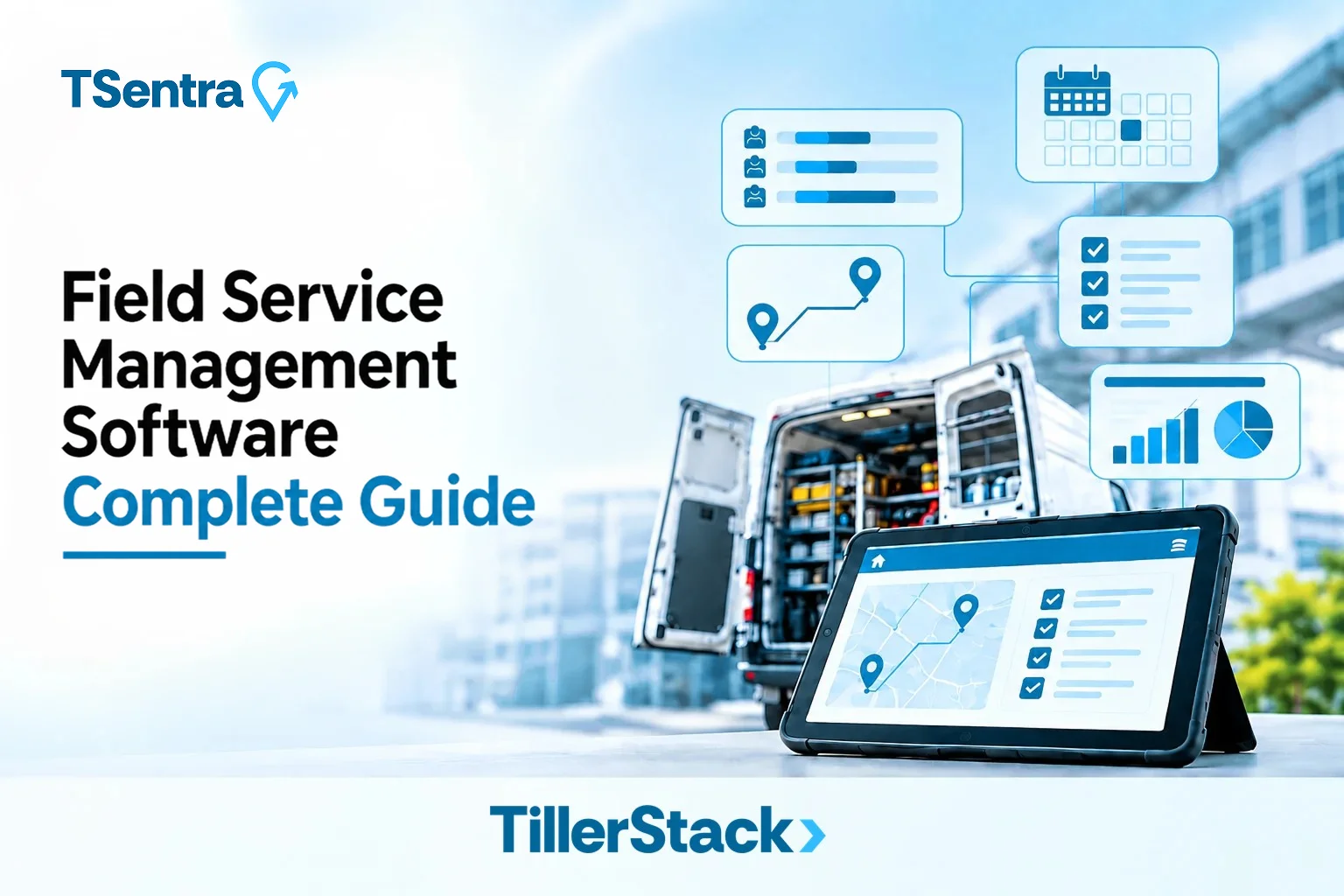
Greater Efficiency in Field Service – with TSentra from TillerStack
Service organizations face growing challenges: rising customer expectations, skilled labor shortages, and increasingly complex service processes. At the same time, jobs must be scheduled faster, resources used efficiently, and service work documented reliably.
With TSentra, TillerStack’s Field Service Management platform, companies digitize their entire field service operation – from scheduling and dispatching to mobile service execution, reporting, and analytics.
Thanks to AI-powered planning, real-time transparency, and seamless integrations, TSentra helps companies to:
plan service calls more efficiently
shorten response times
increase first-time fix rates
reduce operating costs
sustainably improve service quality
Whether telecommunications, utilities, manufacturing, facility management, or logistics, TSentra flexibly adapts to the requirements of a wide range of service organizations.
What is Field Service Management?
Field Service Management (FSM) encompasses the digital planning, management, and optimization of all field service processes – from order creation to the successful execution and documentation of a service call.
Modern Field Service Management software connects scheduling, dispatching, mobile applications, asset management, and reporting on a central platform. This creates end-to-end digital processes that provide transparency, improve collaboration, and make service operations more efficient.
Unlike manual processes involving phone calls, paper, or isolated systems, a modern FSM platform enables all service activities to be managed in real time.
Why Field Service Management is essential today
Technical service organizations must meet growing demands every day:
increasing service and SLA requirements
more complex equipment and infrastructure
skilled labor shortages
rising operating costs
decentralized service teams
higher documentation and compliance requirements
At the same time, customers expect fast response times, transparent communication, and a high first-time fix rate.
A modern Field Service Management platform provides the foundation for efficient service processes. It automates recurring tasks, supports dispatchers with scheduling, and creates transparency across orders, resources, and service teams.
Why companies choose TSentra
TSentra brings all technical field service processes together on a central platform. From scheduling and mobile service execution to reporting and integrations, the solution helps companies manage their field service operations efficiently and with the future in mind.
Your benefits
AI-powered scheduling and dispatching
Real-time overview of orders, teams, and resources
Mobile applications for service technicians
Seamless ERP, CRM, and ticketing integrations
Digital documentation and compliance
Real-time dashboards and analytics
AR- and AI-powered remote support with Osra+
Scalable platform for mid-sized companies and enterprise organizations
The biggest challenges in modern field service
Across industries, service organizations face similar challenges: rising service volumes, complex dispatching, limited resources, and high expectations for response times and service quality. At the same time, documentation obligations and SLA requirements continue to increase.
TSentra helps companies address these challenges efficiently with intelligent workflows, automation, and real-time data. The result is shorter response times, higher resource utilization, and greater transparency across the entire service process.
The key features of TSentra
TSentra brings all technical field service processes together on a central platform. Dispatchers, service managers, and service technicians always work with the same up-to-date information – from scheduling to the analysis of completed service orders.
Intelligent Scheduling & Dispatching
Efficient scheduling is the foundation of fast and cost-effective service. TSentra helps dispatchers plan service calls optimally, either automatically or manually.
The AI takes into account, among other things:
Qualifications and certifications
Availability and utilization
Locations and travel times
Priorities and SLA requirements
Required spare parts and resources
Orders can be adjusted flexibly at any time using drag and drop. This reduces travel time, avoids idle time, and increases field service productivity.
Real-time transparency across all service calls
TSentra provides a central overview of all ongoing service processes. Dispatchers can see at any time which orders are being processed, which technicians are available, and where action is required.
The platform provides real-time information on:
Service calls and order status
Available technicians
Vehicle and job locations
SLA deadlines
Open orders
Interactive maps, Gantt views, and dashboards enable fast decisions and flexible service control.
Mobile support for service technicians
With the TSentra mobile service app, service technicians have all relevant information at their fingertips at all times – online and offline.
This includes:
Work orders
Customer and asset data
Checklists
Service histories
Documentation
Photos and spare-parts information
All changes are synchronized automatically as soon as an internet connection is available again, keeping the data up to date at all times.
AI for smarter service processes
TSentra uses artificial intelligence to support dispatchers with daily scheduling and continuously optimize service processes.
The platform helps to:
Automatically prioritize service calls
Use resources optimally
Reduce travel times
Balance workloads
Continuously improve service quality
This automates routine tasks and creates more time for value-adding activities.
Seamless integration into your system landscape
TSentra integrates easily with existing enterprise systems and enables end-to-end digital processes.
Supported systems include:
ERP systems
CRM solutions
Ticketing systems
Asset management
Warehouse management
GIS applications
Custom API interfaces
This eliminates duplicate data entry and makes information centrally available to everyone involved.
Reporting & Analytics
Sound decisions require reliable data. TSentra provides all relevant service KPIs in real time and supports companies in continuously optimizing their processes.
Analyses include:
SLA compliance
Response times
First-time fix rate
Service team productivity
Travel times
Resource utilization
Service quality
Custom dashboards create transparency and provide the basis for data-driven decisions.
One platform for the entire service process
TSentra supports the entire lifecycle of a service call – from order creation and scheduling through execution to documentation and analysis.
All processes come together on one central platform. This reduces administrative effort, improves collaboration between back office and field service, and creates the foundation for more efficient and cost-effective field service.
Which Field Service Management software is right for you?
Requirements for Field Service Management software vary depending on industry, company size, and existing IT landscape. While some solutions focus on CRM or IT service, others are designed specifically for technical field service or complex enterprise processes.
What matters is not the number of features, but how well a solution integrates into your service processes and supports your teams in their day-to-day work.
What companies should consider when choosing a solution
A modern Field Service Management platform should do more than scheduling alone. It digitally maps the entire service process and creates the foundation for efficient, scalable operations.
Important selection criteria include:
Intelligent scheduling and dispatching
Mobile applications with offline functionality
Real-time overview of orders and resources
ERP, CRM, and API integrations
Asset and maintenance management
Reporting and KPI dashboards
AI-powered automation
Remote support and augmented reality
High scalability and future readiness
Why companies choose TSentra
TSentra combines the capabilities of a modern Field Service Management platform in one central solution – from scheduling to service analytics.
Compared with many point solutions, companies benefit from:
a central platform for all service processes
AI-powered scheduling and dispatching
mobile applications for the entire field service organization
complete transparency across orders and resources
flexible ERP, CRM, and API integrations
AR- and AI-powered support through Osra+
a scalable solution for mid-sized companies and enterprise organizations
The result is more efficient service processes, shorter response times, and sustainably higher service quality.
Field Service Management for every industry
Every industry places different demands on technical field service. While telecommunications companies manage large network infrastructures, manufacturing focuses on maximum asset availability and facility management on short response times.
TSentra adapts flexibly to your processes and helps service organizations plan jobs efficiently, use resources optimally, and sustainably improve service quality.
Telecommunications
The expansion of fiber and mobile networks, fault resolution, and maintenance work require precise scheduling and compliance with demanding SLA requirements.
With TSentra, you coordinate installations, maintenance, and fault resolution centrally on one platform. Real-time transparency, intelligent dispatching, and mobile service processes enable faster handling and higher network availability.
Ideal for
Network operators
Fiber providers
Telecommunications service providers
Learn more → Telecommunications
Energy & Infrastructure
Utilities must operate critical infrastructure reliably, coordinate maintenance, and resolve faults quickly. At the same time, requirements for safety, compliance, and documentation are increasing.
TSentra supports you in planning maintenance, inspection, and fault-resolution jobs and provides transparency across assets, resources, and ongoing work.
Ideal for
Energy providers
Municipal utilities
Network operators
Infrastructure companies
Learn more → Energy & Infrastructure
Transport & Logistics
High vehicle availability and short downtime are essential for cost-effective operations. Maintenance and repairs must be planned efficiently and service teams coordinated optimally.
With TSentra, you manage maintenance processes centrally, optimize service routes, and keep vehicles, resources, and service orders in view at all times.
Ideal for
Logistics companies
Transport operators
Fleet operators
Learn more → Transport & Logistics
Manufacturing & Production
Unplanned machine downtime causes high costs and reduces productivity. Predictive maintenance therefore becomes a decisive competitive factor.
TSentra supports maintenance teams in planning, executing, and documenting maintenance work and creates transparent processes across the entire asset lifecycle.
Ideal for
Manufacturing companies
Mechanical and plant engineering
Process industries
Learn more → Manufacturing & Production
Facility Management
Buildings, technical systems, and infrastructure must be operated reliably. At the same time, clients expect fast response times and complete documentation of all services.
TSentra digitizes maintenance, inspection, and service processes and supports facility service companies with efficient scheduling and transparent service delivery.
Ideal for
Building service providers
Technical facility management
Operators of large real-estate portfolios
Learn more → Facility Management
Oil & Gas
Complex assets, high safety requirements, and widely distributed job sites require precise planning and maximum transparency.
With TSentra, you coordinate maintenance and inspection work efficiently and document all activities traceably. Osra+ additionally supports service technicians with remote expert support and AI assistance.
Ideal for
Refineries
Pipeline operators
Energy and industrial companies
Learn more → Oil & Gas
Emergency services organizations
Fire departments, emergency medical services, and other response organizations need an up-to-date overview of personnel, resources, and ongoing incidents at all times.
TSentra supports control centers and incident management teams with intelligent dispatching, real-time information, and digital documentation – enabling faster coordination and efficient operations.
Ideal for
Fire departments
Emergency medical services
Aid organizations
Public authorities
Learn more → Emergency services organizations
One Platform for All Service Organizations
Regardless of industry or company size, TSentra helps companies digitize service processes, use resources efficiently, and optimize collaboration between back office and field service.
The result is shorter response times, higher first-time fix rates, transparent processes, and sustainable improvements in service quality.
Discover the right industry solution for your company.
Why Companies Trust TillerStack
For more than 25 years, TillerStack has helped companies digitize their service processes and make technical field service more efficient. With TSentra and Osra+, service organizations get an integrated solution that combines scheduling, mobile service processes, AI, and augmented reality on one central platform.
Whether a mid-sized company or an international corporation, TSentra grows with your requirements and integrates flexibly into existing system landscapes.
Your benefits at a glance
Greater service efficiency
Automated scheduling, intelligent dispatching, and optimized processes reduce response times and increase field service productivity.
More transparency
Keep orders, service teams, resources, and service KPIs in view at all times – for informed decisions and better management of your service organization.
Seamless integration
TSentra integrates with ERP, CRM, ticketing, and asset management systems and creates end-to-end digital processes without system breaks.
Future-ready technology
AI-powered automation, augmented reality, and a scalable architecture provide the foundation for high-performing, future-ready field service.
Digitalization starts with a strong service platform
Efficient field service does not come from individual digital tools, but from the interaction of scheduling, mobile applications, data, and intelligent workflows.
TSentra combines these capabilities on one central platform and helps companies manage service processes efficiently, reduce operating costs, and sustainably improve service quality.