



A field service digital approach transforms work processes by replacing traditional paper methods and isolated software applications with unified systems that enhance operational visibility, process integration, and decision-making.
The transformation enables organizations to manage their assets more effectively, reduce response times, and maintain consistent service experiences across locations, even as operational demands continue to grow.
The digital transformation in field service requires more than software adoption because it brings a fundamental shift in how service teams operate and deliver value. The system aligns people, processes, and technology to enable instant communication, proactive maintenance, and performance optimization.
Organizations must become more agile, scalable, and resilient to remain competitive in dynamic environments, especially as customer expectations evolve. Many companies adopt digital transformation as a service because it enables them to accelerate their changes without exhausting internal resources.
What Does Digital Transformation Mean in Field Service?
Digital transformation in field service introduces new practices for service organizations by replacing manual processes with integrated data systems that span their entire organization.
Key elements of this transformation include:
Traditional vs Digital Service Model
Traditional service models rely on paper-based work orders, which often lead to delays and repeat visits. In contrast, field service digital models operate with centralized data systems that handle automated scheduling tasks, enabling better service through increased operational efficiency.
Shift from Reactive to Predictive Service
Traditional field service usually addresses problems only after equipment fails. Digital systems enable organizations to adopt a proactive maintenance strategy by incorporating historical data, performance trends, and monitoring insights to forecast future issues.
Service Lifecycle Digitization
Digital transformation connects every phase of the service lifecycle, from request intake and work order creation through execution, reporting, and analysis. Automated workflows reduce manual errors, establish standardized procedures, and generate operational insights that support continuous improvement.
Why Digital Transformation Is Critical for Field Service Organizations
The importance of digital transformation in field services has become essential, as service organizations need to address increasing customer demands while managing complex assets and addressing operational shortcomings.
The demands of customers today require businesses to provide immediate assistance, which includes accurate scheduling, real-time updates, and issues resolved on the first visit, which manual systems and disconnected systems cannot provide.
At the same time, technicians require access to comprehensive asset information, including service history and performance data, as assets become more advanced and interconnected.
Digital transformation enables organizations to boost employee productivity and overcome prevalent field service challenges. Technicians are hindered by the need to handle manual scheduling and paperwork, leading to reduced productivity, and skill shortages further underscore the importance of effective resource allocation.
Organizations can achieve operational efficiency by automating workflows and enabling mobile access to manage daily tasks and deliver services faster. The organization can use this information to make data-driven decisions that help it identify operational problems, optimize resource planning, and enhance its services.
The Key Elements of Digital Transformation in Field Service
The field service digital transformation strategy succeeds by leveraging technology and personnel to solve operational problems and enhance service delivery. Rather than relying on separate tools, organizations are now seeking an integrated system that merges field service management software with automation and data analytics. Digital transformation as a service offers teams a pathway to build modern systems by enabling gradual improvements.
Cloud-Based Field Service Management Software
Cloud FSM solutions provide businesses with a unified platform to access work orders, schedules, asset data, and service history. Cloud-based field service management software enables businesses to expand their operations while delivering real-time updates to all team members, a feature that distinguishes it from on-premises systems.
The system shared information among dispatchers, technicians, and managers, enabling them to work more effectively, reducing system maintenance costs, and accelerating innovation.
Mobile Workforce Enablement
Digital transformation requires organizations to provide mobile tools that empower technicians to perform their work. Field workers can access their job details, asset documentation, checklists, and customer history through mobile field service management solutions that operate on their devices.
Through this approach, it eliminates paper documentation, which can lead to mistakes, but allows technicians to resolve problems more efficiently during their initial visit. Mobile technology enables teams to communicate with dispatchers in real time, enhancing their ability to respond and overall workforce productivity.
Real-Time Data & Analytics
The organization uses data as its key driver of transformation while maintaining real-time data access, enabling better decision-making. Field service analytics combine data from service operations, technician performance, and asset condition to provide actionable insights.
The analytics system helps organizations to quantify performance, predict demand, and enforce continuous process improvement.
IoT & Connected Assets
Connected devices create an entirely new way for organizations to maintain and service assets. IoT in field service provides continuous monitoring of equipment performance, usage patterns, and environmental conditions.
The process generates valuable insights that organizations use to develop proactive maintenance and predictive maintenance strategies that decrease downtime and operational expenses. The connected assets provide technicians with a clearer understanding, helping them prepare for on-site work and improve service accuracy.
AI & Intelligent Automation
AI technology enhances digital transformation by enabling smarter, faster service operations. AI in field service management supports automated scheduling, intelligent dispatching, and predictive maintenance recommendations.
The implementation of AI-driven automation reduced the need for manual effort in tasks such as report generation, diagnostics, and issue prioritization. Intelligent automation enhances operational efficiency by allowing teams to focus on the most important service activities.
System Integration (ERP, CRM, Asset Systems)
The digital transformation demands seamless data flow across the enterprise’s systems. FSM integration links the field service platforms to the ERP, CRM, and asset management to avoid data silos. This ensures consistency across billing, inventory, customer records, and service history. The integrated systems enhance operational accuracy, reduce duplicate data entry, and provide complete insights into service performance across the organization.
Governance, Change Management & Adoption
The use of technology is not a guarantee of success. The digital transformation issues demand that organizations develop decisive control, implement systematic change management, and devise viable user adoption strategies.
Effective FSM implementation includes training, process alignment, and continuous support, which help teams use new features. Organizations that prioritize adoption and governance will achieve sustainable digital transformation benefits while maintaining consistent service standards.
Benefits of Digital Transformation in Field Service
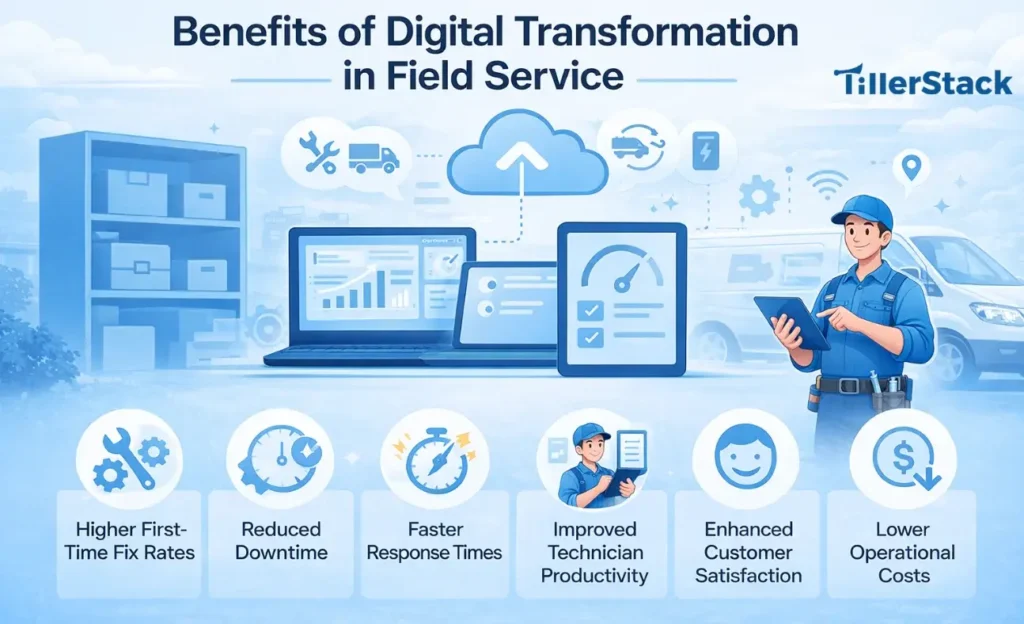
The implementation of field service digital capabilities enables organizations to develop service systems that operate more efficiently and adaptively while preserving their ability to expand.
Digital tools support field service modernization, enabling organizations to achieve better service performance through enhanced operational visibility, workflow automation, and the ability to make data-driven decisions.
Higher First-time Fix Rates
Digital transformation enables technicians to access asset records, service records, and diagnostic details instantly before leaving the office. Such a level of field service provides technicians with the necessary equipment and full information, leading to an increased first-time success rate and a reduced number of return visits to customers.
Reduced Downtime
Organizations use connected systems and proactive maintenance capabilities to detect potential issues before they cause asset failure. Digital monitoring and predictive insights enable service teams to identify issues early, which helps them reduce unexpected downtime while maintaining ongoing operations.
Faster Response Times
Automated scheduling, intelligent dispatching, and real-time communication enable faster response to service requests. Digital workflows reduce the need for manual coordination while enhancing workflow visibility, enabling teams to handle emergency tasks and fulfil customer needs more effectively.
Improved Technician Productivity
The opportunity to view work orders, checklists, and reporting tools on mobile devices will eliminate the need for paper documents and minimize administrative delays. Technicians could spend less time on manual work and more time solving the problem, hence being more productive.
Enhanced Customer Satisfaction
The most important factors that build customer trust in businesses are their ability to provide consistent information and their dedication to open communication. Digital systems provide accurate arrival times, status updates, and detailed service records, resulting in better customer experiences and long-term relationships.
Lower Operational Costs
Digital transformation reduces total service expenses through three methods: better scheduling, fewer repeat visits, and reduced downtime. Organizations need to invest in digital transformation to grow their field service operations while managing expenses through improved resource efficiency.
Challenges in Implementing Digital Transformation in Field Service
Organizations often encounter digital transformation challenges in field service during implementation, despite the ability to achieve operational benefits from digital initiatives. One of the most common issues is their need to change existing practices.
The field technicians and dispatch teams accustomed to a well-established workflow will also be reluctant to embrace new tools, especially when the value is not well documented or the training is inadequate. In the absence of effective change management, companies will experience adoption issues, leading to their systems not being used as expected.
Another major obstacle involves field service technology barriers, which specifically affect both legacy systems and data silos. Many organizations still use outdated platforms that lack direct compatibility with current digital solutions.
The lack of interoperability results in inconsistent data, duplicated effort, and limited visibility across service operations.
Digital transformation requires workers to acquire new mobile technology skills, including mobile device use, data interpretation, and standardized digital reporting.
Without proper training and ongoing support, the team’s productivity will initially drop, causing frustration among team members. Digital initiatives suffer from fragmentation when organizations lack defined ownership, performance metrics, and long-term planning.
The Future of Digital Field Service
The future of field service management depends on technological advancements that create intelligent systems capable of delivering services faster and more efficiently.
The field service industries currently view predictive service as its most important digital trend, which combines data from connected assets and historical performance to identify future equipment failures before they occur.
Technicians receive assistance through on-site remote support and augmented reality to perform their jobs more effectively. With remote expert support and AR-guided workflows, technicians can address complex issues more quickly, reducing the need for follow-up visits.
At the same time, AI-driven optimization now enhances scheduling, dispatching, and maintenance planning by continuously learning from operational data.
Looking ahead, autonomous workflows will create more efficient operational processes that handle basic tasks through automation, enabling field service organizations to grow their operations while maintaining high service quality.
Conclusion
Digital transformation has become essential for organizations that aim to remain competitive and responsive. The increasing complexity of service operations requires organizations to implement digital tools that improve operational efficiency, operational control, and decision-making capabilities across their service processes.
This transformation is driven by field service management software that unifies teams, data, and processes within a connected system. Digital transformation strengthens operational performance when done right, allowing organizations’ technicians to do their jobs better, improving the customer experience, and equipping their business for future service needs.
FAQS
- What is digital transformation?
Digital transformation is the integration of digital technologies into business processes to improve efficiency, visibility, and decision-making.
- Why is digital transformation important for field service companies?
Digital transformation is essential for field service companies because it helps address rising customer expectations, complex assets, and workforce coordination challenges.
- How does digital transformation improve field service efficiency?
It improves efficiency by automating scheduling, dispatching, reporting, and communication.
- What are the key elements of digital transformation in field service?
Key elements include cloud-based field service management software, mobile workforce enablement, real-time data and analytics, IoT-connected assets, AI-driven automation, system integration, and effective change management.
- Which technologies enable digital transformation in field service?
Core technologies include cloud platforms, mobile applications, IoT sensors, artificial intelligence, data analytics, and integrated ERP and CRM systems that support end-to-end digital service operations.
- How does IoT support digital field service operations?
IoT enables continuous monitoring of assets and supports predictive maintenance, reduces unplanned downtime, and helps technicians arrive on-site better prepared.
- What challenges occur during field service digital transformation?
Common challenges include resistance to change, legacy system integration issues, data silos, skills gaps, and unclear governance.
- How does field service management software support digital transformation?
Field service management software provides central service data management with automated workflow processes while allowing technicians to access information through mobile devices and connecting to enterprise systems which create a base for building digital field service operations.