



FSM and OSRA Integration: One Platform, Endless Possibilities
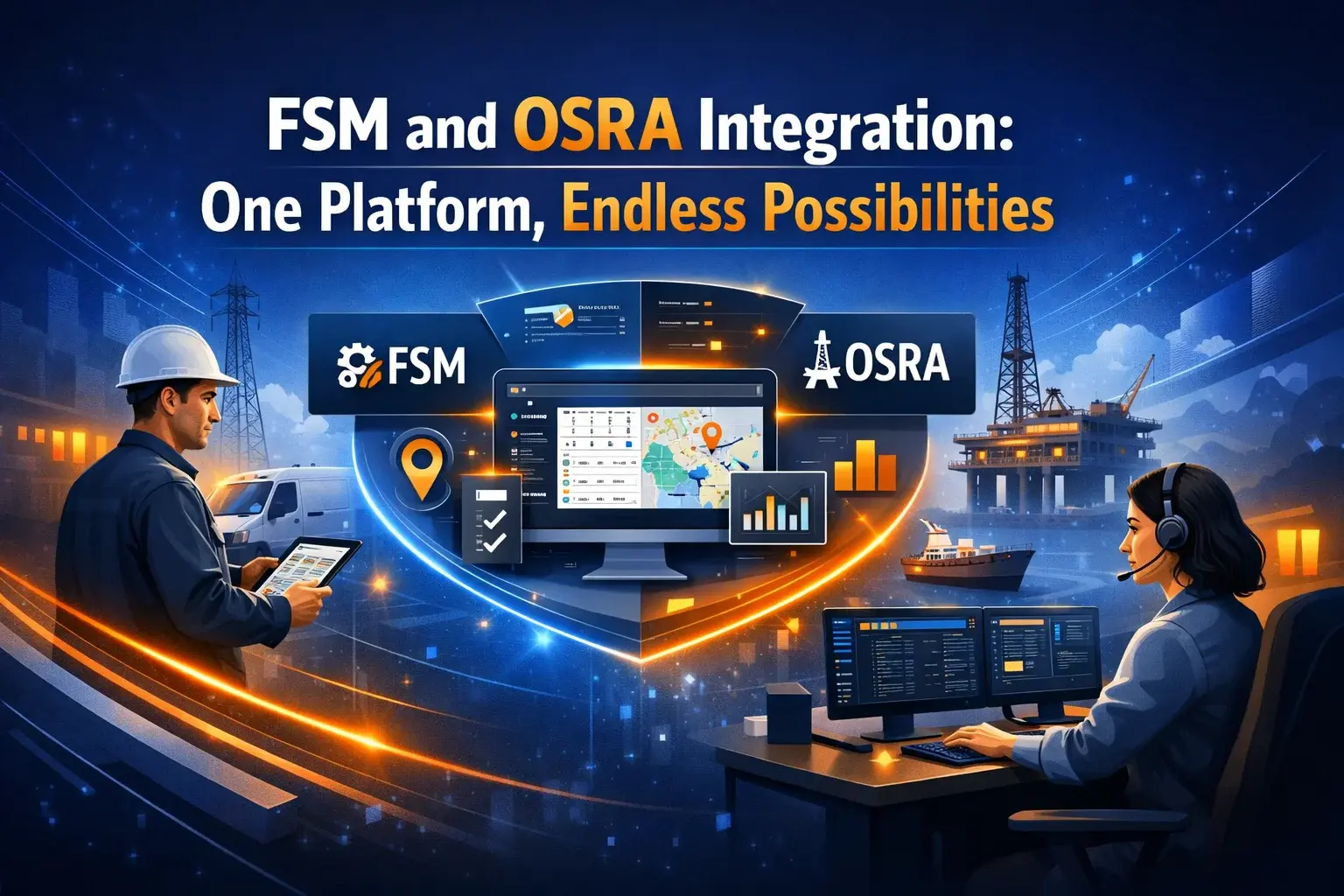
Field service jobs are becoming increasingly sophisticated, which means it has become necessary for technicians to handle advanced equipment, tighter SLAs, and unexpected issues in real time.
While field service management software supports scheduling, dispatch, and tracking work, it often falls short when technicians need prompt guidance on-site from an expert.
Depending solely on Field Service Management (FSM) estimates, every technician has all the answers, which is rarely the case in today’s field environments.
Autonomous onsite remote assist tools immediately solve the expertise gap by connecting technicians with remote specialists. However, when the software is used in isolation, it will lack operational context and workflow continuity.
This is the primary reason why Field Service Management (FSM) and On-Site Remote Assist (OSRA) coordination is crucial. By integrating job execution and real-time expert support into a single platform, organizations can reduce delays, avoid repeated visits, and resolve issues more quickly.
Through this, field service operations will become more efficient, connected, and reliable.
What Is Field Service Management (FSM)?
Field Service Management (FSM) is the process of organizing and monitoring operations that take place outside a company, ensuring that the various elements required for service, such as technicians, work orders, and resources, are managed in a way that meets the service demand.
In a nutshell, FSM aims to link the appropriate personnel, machines, and data to the job site at the correct time, which in turn prevents delays and minimizes the occurrence of onsite visits.
Organizations nowadays are utilizing modern field service management software to manage this complexity, leveraging tools for scheduling, dispatching, managing work orders, and tracking technicians in real-time.
Scheduling ensures that jobs are assigned appropriately, considering location, skill set, and priority, while dispatch tools allow managers to cope with changes, such as emergency requests or technician availability.
Work order management provides visibility into task details, required parts, and completion status, creating accountability and accurate reporting.
FSM software is also key to a business’s day operations by providing reliable service, reducing downtime, and improving customer satisfaction.
Nowadays, technicians heavily rely on FSM to stay informed about the jobs they are about to take on, access job histories, and record the work they have completed, while managers gain insights into workforce productivity and resource utilization.
By consolidating field operations, FSM software transforms reactive field service into a proactive, organized, and measurable process.
What Is OSRA (Onsite Remote Assist)?
On-site Remote Assist (OSRA) is a remarkable technology that enables field technicians to receive immediate support from remote experts while performing tasks on-site.
OSRA connects the field execution and specialized expertise through live visual feeds, interactive annotations, and two-way communication. Through this, technicians can troubleshoot intricate problems without waiting for an expert to travel on-site.
Common capabilities of OSRA consists of:
- Live video assistance: Experts can see exactly what the technician sees, allowing them to give accurate guidance.
- Screen sharing and annotations: Visual prompts and instructions can be integrated visually on real equipment or digital schematics for clarity.
- Remote expert guidance: Specialists can provide step-by-step instructions, troubleshooting tips, or safety advice, all in real time.
By consolidating remote assistance for field service directly into workflows, OSRA enables technicians to resolve issues faster, reduce repeat visits, and improve overall service efficiency.
The Challenge of Managing FSM and Remote Assist Separately
Utilizing various tools for FSM and remote support to manage field service operations can lead to significant service inefficiencies.
When technicians are provided with disconnected field service tools, they must switch between systems to access work orders, request expert guidance, and document completed tasks.
This uncoordinated workflow might create situations where manual coordination, miscommunication, and slow problem resolution occur.
Additionally, without consolidation, experts can be completely unaware of critical information regarding the job, asset history, or troubleshooting steps, which could lead to knowledge gaps. Guidance delays often cause longer service times, repeat visits, and dissatisfied customers.
To put it simply, relying on separate FSM and onsite remote assist tools prevents teams from operating efficiently, limiting the overall effectiveness of field services and driving unnecessary costs.
How FSM and OSRA Integration Creates a Unified Service Platform
Integrating FSM and OSRA optimizes fragmented field service workflows into a unified field service platform, connecting work execution with expert assistance to provide faster and more reliable service.
The interplay between job management and real-time guidance enables the establishment of a comprehensive workflow in the organization’s field service operations, encompassing every step from job creation to resolution.
This also enables managers and support teams to have a unified view of the status, resource utilization, and performance indicators.
Linking Work Orders with Live Remote Assistance
Through FSM and OSRA integration, technicians can initiate remote support sessions directly from a work order.
A remote expert is instantly informed of all critical job details, such as asset information, service history, and necessary parts.
This seamless connection eliminates the need for manual context sharing, ensuring that guidance is precise, timely, and fully recorded in the job file.
By incorporating remote assistance into the work order, field service teams reduce errors, avoid miscommunication, and automate issue resolution.
Real-Time Collaboration Between Technicians and Experts
The unification enables real-time collaboration, allowing technicians and remote specialists to communicate through visuals and interact with each other.
Professionals can mark live video streams, assist with complex repairs, and verify each step as it is being performed.
This collaborative method reduces the number of visits, increases the first-time fix rates, and enables technicians to handle challenges they might not be able to solve alone.
For supervisors, it allows them to track the status of field service jobs, evaluate performance, and apply resources across the service network most effectively.
Key Use Cases of FSM and OSRA Integration
Faster Issue Resolution with Live Expert Support
The combination of field service work orders and onsite remote assist indicates that technicians can receive a prompt response from remote experts, without waiting for a knowledgeable person to arrive at the site.
This optimizes the process of error resolution, minimizing downtime, and ensures that even complicated issues are fixed promptly. Immediate access to expert knowledge maintains smooth service and enhances customer satisfaction.
Reducing Repeat Visits and Escalations
Technicians with remote support access will, especially during live work, find it an advantage, as the chances of problems being resolved instantly at the first attempt are higher.
The adoption of remote support with FSM ensures that every action is documented and performed correctly, thereby decreasing the number of repeat visits, lowering the number of escalations, and increasing operational efficiency.
Supporting Junior Technicians in the Field
On-site remote assist is assessed as a training and mentorship approach. This means that less experienced or junior technicians can perform complex tasks under the guidance of experts while learning in real-time and completing actual jobs.
Through knowledge transfer, it empowers the workforce, builds confidence, and maintains high-quality service across the team.
Benefits of Integrating FSM and OSRA
The unification of on-site and remote assistance has a significant impact in terms of operational and business advantages across field service organizations.
The benefits of FSM integration extend beyond mere convenience, directly improving service quality, workforce productivity, morale, and customer outcomes.
One of the most immediate gains is an improved first-time fix rate, a key indicator of field service efficiency.
Fun Fact
According to industry reports, companies that use modern field service management technology often see first-time fix rates rise significantly, resulting in top-tier teams achieving as high as 85–90% of cases being solved on the first visit, while the average rates for non-optimized systems are approximately 70–77%.
Remote assistance during service calls helps build trust and reliability, thereby highlighting the benefits of a unified platform for remote assistance.
Impact on Field Technicians, Managers, and Customers
The combination of FSM and OSRA has a noticeable and beneficial effect on both field service teams and customers.
When experts provide guidance in real-time during difficult tasks, field service technicians become more self-assured and less stressed, as the situation is no longer uncertain.
According to industry standards, top service companies achieve first-time fix rates of 85% and above, while the average rate is below 75%, which helps technicians complete their work correctly on the first visit.
A unified platform used by managers improves visibility into job development, technician workload, and active support sessions, directly increasing service team productivity.
According to research, modern FSM tools can help organizations to do as much as 2 more daily jobs per technician through better scheduling and fewer repeat visits.
Did you know? Customers benefit from faster, more reliable service outcomes. Customer satisfaction in field service is enhanced by fewer delays and repeat visits—particularly since 78% of customers today demand real-time service updates as part of a positive service experience.
Why a Single Platform Matters More Than Multiple Tools
Using multiple separate tools for field service and remote support complicates the situation, requires frequent context switching, and increases the likelihood of data gaps.
A unified service platform eliminates these operational gaps by integrating scheduling, work orders, and on-site remote assistance into a single workflow.
With integrated field service software, all job details, asset histories, and remote guidance are stored in one place, ensuring better data continuity and minimizing errors usually caused by unintegrated data.
Management and technical staff will have access to full and current records without requiring system changes, thereby enabling better decision-making and increased responsibility.
A combined FSM and OSRA platform also supports adaptive systems. In the event that a service team expands or processes a change, the organization has the option of avoiding the expensive and complicated integration of multiple tools.
Conclusion – One Platform, Endless Possibilities
The merging of FSM and OSRA is a prime example of how modern field service operations can gain efficiency, accuracy, and reliability by integrating execution with real-time expert support. The technicians are more confident, managers have a better view, and customers are receiving faster and more reliable service.
Organizations can eliminate workflow gaps, minimize repeat visits, and enhance service team productivity by integrating scheduling, work orders, and remote onsite assistance in a single platform. Through this, it will prove that integrated solutions are the future of modern field service management.
TillerStack embodies this vision as a comprehensive, all-in-one platform that provides seamless FSM and OSRA integration, empowering field teams, simplifying operations, and maximizing the value of service interactions.
Would you like to upgrade your field service operations? Explore TillerStack today and find out how a unified platform can enhance your team’s productivity and customer satisfaction.
FAQ Questions
- What is FSM and OSRA integration?
The integration of FSM and OSRA merges the functions of the field service management, which include scheduling, dispatch, and work orders, with onsite remote assist capabilities. It enables technicians to receive real-time expert support directly within their service workflows, creating a single platform for execution and assistance.
- What does OSRA (Onsite Remote Assist) mean in field service management?
OSRA (Onsite Remote Assist) refers to technology that allows field technicians to consult and collaborate with remote experts using live video, visual markings, and real-time communication during the execution of onsite jobs. It helps technicians to fix problems that are hard to solve.
- How does onsite remote assist work with field service management software?
When integrated with field service management software, onsite remote assist can be deployed directly from a work order. Job details, asset history, and service context are automatically made available to remote experts, guaranteeing quicker and more precise guidance in real time during service calls.
- What problems does FSM and OSRA integration solve for field service teams?
The integration of FSM with OSRA means no more isolated applications, no further manual coordination, and no more knowledge gaps. It shortens the time needed for service, minimizes repeat visits, and makes sure that the technicians have the support of the experts right away. Optimizing field service operations from start to finish.
- How does remote assist improve first-time fix rates in field service?
With the help of remote assist, it improves first-time fix rates since technicians will be able to ask for experts’ advice during live consultations if any unexpected problems arise. Technicians are also supported through visual guidance and in a step-wise manner, which finally results in the accuracy of repairs being assured during the first visit.
- Can FSM and OSRA integration reduce repeat service visits?
Certainly, the integration greatly lowers the number of repeat visits and the unnecessary escalations by fixing issues accurately during the first visit and the documentation of expert advice within work orders.
- Which industries benefit most from FSM and onsite remote assist integration?
The sectors, such as manufacturing, utilities, telecommunications, energy, healthcare, and industrial maintenance, stood first on the list of beneficiaries from technologies like complex equipment and distributed field teams.
- How does FSM and OSRA integration help field service technicians?
The integration helps technicians by receiving real-time expert guidance, reducing uncertainty during intricate jobs, and improving confidence. Moreover, it also allows for constant skill development through live knowledge transfer while the job is being executed.
- What are the main benefits of using one platform for FSM and remote assist?
With the use of a single platform, it becomes easier to manage the entire process, and there is better continuity of data and less need to switch tools. A unified system enhances visibility, increases productivity, and supports scalable field service operations with fewer integrations.
- Is FSM and OSRA integration suitable for growing field service businesses?
Undoubtedly, the integration of FSM with OSRA is extremely adaptable and it permits the expansion of field service companies to the extent that they can support larger teams, handle more difficult jobs, and still be able to provide good service quality without increasing operational challenges.