



Field Service Management is the strategic and revolutionary coordination of people, equipment, and inventory to perform services outside of the company’s property. Thus, the future of field service management software is a critical discussion for 2026 and beyond.
The working landscape is continuously evolving and rapidly moves from optimization to full digital transformation. This shift is primarily driven by customer expectations, digital transformation, Artificial Intelligence, and remote working among others. To harness these challenges into opportunity organizations must look ahead and consider the future of field service industry.
In this article, we will explore the latest trends, emerging technologies, and remote first solutions that is shaping the future of the industry.
Why the Future of Field Service Matters Today
Today’s need for field service industry transformation is driven by a combination of service management trends which includes:
- Rising Customer Expectations- Customers anticipate a personalized, transparent, convenient, and proactive service. They demand transparency in terms of real-time tracking and prefers self-service options for other aspects such as scheduling
- Intense Competitive Pressures – Research shows a rapid increase in customer’s standards each year. Thus, this created an intense pressure for organizations to achieve faster response times and create proactive service models.
- Digital Disruption Reshapes the industry – When field technology embraces digital disruption it reshapes management trends. Some examples include use of Artificial Intelligence in automate critical tasks. It also uses Trusted data platforms enabling predictive maintenance.
This major shift in technology shows that the Future of Field Service Management matters highly today, because it is here! It is needed in overcoming operational challenges, and ensures sustainable success in a highly competitive market.
Field Service Management Trends Defining 2026 and Beyond
Customer-Centric Experiences and Personalization:
AI, Automation and Predictive Service
Internet-of-Things (IoT), Sensors, and Data-Driven Decisions
Sustainability in Field Service
The Role of Remote Field Service in the Future:
The Shift to Remote-First Operations
Remote Assistance for Field Service Technicians
Remote Field Service Software and Tools
How Field Service Organizations Can Improve Effectiveness
To ensure the effectiveness of field service organization (FSO), these three areas must be given a primary focus:
Training and Empowering Technicians
Upskilling the workforce in digital tools (like AR/VR and mobile FSM apps) is critical to combat the shrinking talent pool. The data collected is used to expand the knowledge and train personnel of field service organizations.
2. A strong knowledge management systems allows instant access to diagnostic and procedural information, which is key for improving first-time fix rates.
Building a Smarter Field Service Organizer
- A modern organizer features real-time dashboards, Key Performance Indicators, and heavy automation powered by AI.
- Measurable improvements include faster scheduling and significant reduced downtime by enabling proactive decision-making of the field service organizer.
Metrics That Define Effectiveness
1. Key Performance Indicators to track are the first-time fix rate, customer satisfaction (CSAT), and mean time to repair (MTTR).
2. Using these data-driven insights is vital for continuous improvement and aligning service performance with overall business strategy.
Technology Driving the Future of Field Service Management
Technology in field service is the essential tool for achieving efficiency and meeting exceptional customer expectations. The top field service software trends are made with these three primary considerations:
Cloud and Mobile-First Platforms
1. These platforms allow accessible, real-time updates and communications, centralizing data across the system.
2. Field Service Management apps for field workers and customers support offline work, enable customer self-scheduling, and provide real-time reporting from the field.
AI and Machine Learning in Field Service
- AI enables predictive service models, it analyses past data to determine and solve asset failures proactively, minimizing the downtime.
- Advanced Natural Language Processing (NLP) and Agentic AI automate tasks, assisting dispatchers and processing customer requests through conversational interfaces.
Trend Management Solutions for Strategic Growth
- These are tools/solutions businesses use to anticipate, track, and adapt to industry trends, such as Enterprise Asset Management (EAM) software.
- This highlights the strategic importance of trend management solutions for security, compliance, and driving continuous improvement based on performance analysis.
Field Service Management Beyond 2030
Beyond 2030, the future of field service looks very different. It will be a radical, integrated change brought about by smart automation and advanced augmentation.
Long-Term View: Automation of Digital Operations
- Digital twins and the Internet of Things (IoT) will make maintenance completely predictive, turning FSM into a model of operations that is only proactive.
- Drones will do regular, high-risk inspections on their own and send data directly to work orders for quick action.
Predictions from Experts
- Industry strategy is aggressively shifting to Remote-First mandates minimizing physical deployment.
- The growth of AI Governance systems shows how important it is to manage complex technology in a safe and ethical way on a large scale.
The Human Angle: The Augmented Technician
- The technician’s job will change to that of an Augmented Problem-Solver, using AR/VR data glasses and Voice AI to do more work and solve more complicated problems without using their hands.
- Automating routine tasks frees up workers to focus on high-value, specialized skills and business opportunities.
Challenges in Ethics and the Workforce
- AI taking over jobs is making “digital labour” more common. To give the changing workforce the skills they need, we need proactive, large-scale reskilling programs.
- To make sure that ethical governance happens and to reduce bias in highly automated processes, FSOs must support Responsible AI principles.
Tillerstack: A Powerful and Integrated Field Management System
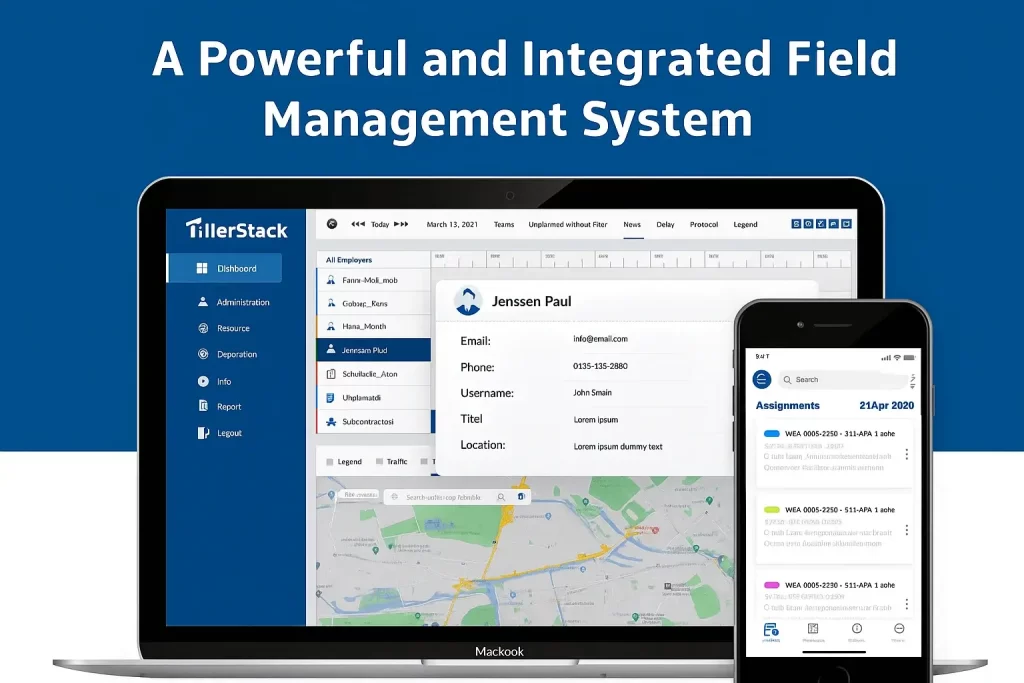
Tillerstack applies cutting-edge field service technology to maximize efficiency and enable its mobile workforce:
- Optimization objectives: It ensures the organization will always meet Service Level Agreements, while increasing efficiencies. The platform improves technician performance and customer experiences by reducing both travel time and costs of work orders.
- Intelligent resource management: It sends the right employee, selected by skills and shortest distance, and assigned with dynamic GPS data.
- Mobile and Remote Capabilities: The mobile application delivers technicians the required data and has offline mode functionality. TillerStack also boosts the operations with dedicated technologies such as On-Site Remote Assist (OSRA) and built-in drone technology, minimizing truck rolls and providing expert support through the augmented reality overlays.
- Centralized Documentation: The solution automates processes, thereby cutting out the manual paperwork since technicians document time and materials using the app, and it automatically sends precise information to headquarters.
Key Takeaways and Action Plans for Field Service Leaders
We are seeing the future of Field Service Management (FSM) being built upon AI, remote solutions, and increased customer expectations.
The Major Trends & Technologies
- Intelligent Automation: Predictive maintenance and autonomous scheduling via Agentic AI and IoT sensors.
- Remote-First: Standardized adoption of tools such as OSRA/Visual Remote Assistant with AR and video for expert assistance.
- Data Advantage: Integrated service data platform that delivers real-time data for front-line technicians and back-office and mobile capabilities.
Next Steps to Take Today
- Adopt Remote Solutions: Use OSRA tools to dispense with “truck rolls,” travel costs, etc., and use AI for customer self-service.
- Invest in Training: Upskill staff on digital tools and AI usage and proficiency with contemporary training methodologies such as AR/VR.
- Begin To Integrate AI & Automation: Integrate Agentic AI to automate redundant tasks, and allow automated optimization of scheduling to meet SLAs every time.
Organizations that make the adaption sooner versus later will be tomorrow’s field service leaders.
Conclusion
The equation to change Field Service Management (FSM) is a complete equation: future of field service = technology + people + process + customer focus. The combination of smarter AI, connected data platforms, and remote assistance tools calls for a coordinated approach to empower the workforce while rising to the challenge of the consumer’s high expectations. Embracing new trends, technologies, and remote options are no longer optional but today’s requirement for competitive viability and sustainable growth. By proactively engaging in the digital imperative, organizations will not only survive but also create and lead a new age in proactive, efficient, and exceptional service delivery.
FAQ’s about Field Service Management
Q1. What is the future of field service management?
The future is characterized by the convergence of AI, remote solutions, and digital transformation to drive efficiency and provide exceptional, proactive customer experiences.
Q2. In 2025, what are the top trends field service management for 2026?
The top trends include automation driven by Artificial Intelligence, predictive service leveraging IoT data, real-time data and a continued focus on customer centricity, and sustainably driven by optimized routing.
Q3. How can field service organizations improve effectiveness?
Improve effectiveness by upskilling technicians in digital tools, building a smarter organizer with automation and KPIs, and using data-driven insights for continuous improvement.
Q4. What role does technology play in the future of field service?
Technology is the backbone that enables predictive service models, hands-free productivity, centralized access to data using the cloud, and real-time decision-making.
Q5. Why is remote assistance important for field service organizations?
AR/video remote assistance decreases the expensive trips and wait times for vehicles, provides immediate expert assistance while on the job, and quickly builds technician knowledge to level them up as skilled tradespersons.
Q6. How will AI impact the field service industry?
AI will impact FSM by allowing Agentic AI to take actions autonomously, optimize scheduling, provide hands-free diagnostics, and be the basis for predictive maintenance.
Q7. What steps should leaders take to prepare for the future of field service?
Leadership must immediately adopt AI, consider OSRA-style remote options, and selectively invest in training to achieve digital fluency and advance their leadership in the industry.