



Ai Benefits in Field Service Management
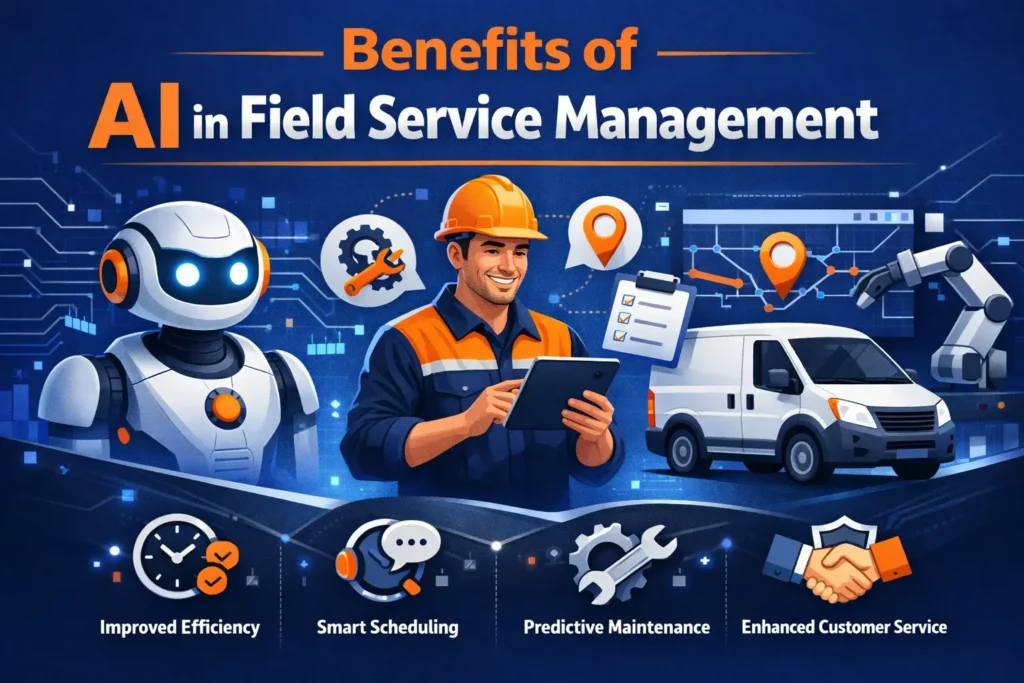
In 2026, field service organizations across industries such as manufacturing, oil & gas, and medical equipment are said to face unprecedented pressure.
Problems such as ever-increasing customer expectations, a shortage of skilled technicians, and stringent budgetary constraints are forcing world leaders to rethink work efficiency.
AI-driven field service management has become the most practical and measurable way to close these gaps. According to the 2025 Service Council benchmark, 77% of service executives report difficulty meeting SLAs due to scheduling complexity and workforce shortages.
As such, this is where state-of-the-art field service AI delivers tremendous gains for any company’s workforce. Predictive maintenance AI prevents failures before they occur, and some AI-powered field service platforms streamline scheduling, automate dispatching, improve asset uptime, and provide technicians with real-time access to knowledge, thereby improving workflow efficiency by eliminating systematic and human errors.
Enhanced Scheduling & Intelligent Dispatching
Aberdeen (2024) says that manual scheduling takes up to 40% more time than automated alternatives.
As work orders become more dynamic, traditional FSM technologies cannot effectively handle real-time fluctuations in project urgency, talent availability, and technical constraints.
AI in field service management tackles this issue through dynamic scheduling and skill-based routing.
What AI-Powered Scheduling Achieves
- It determines the technician’s expertise, proximity, credentials, and availability.
- Creates priority for urgent work immediately.
- Immediate transfer of tasks if circumstances change (traffic, cancellation, emergency).
- It promotes SLA compliance by decreasing scheduling mistakes.
AI scheduling and dispatch minimize unproductive time, enhance technician utilization, and improve the first-time repair rate by deploying the most appropriately qualified technician to each assignment.
A Danish telecoms giant, TDC NET, using IFS AI-powered field service, lowered missed appointments by 28% and halved the scheduling workload. AI consistently adjusts dispatching to reflect real-time changes in the field.
Table: Traditional Scheduling vs AI-Powered Scheduling
Capability | Traditional FSM | AI-Powered FSM |
Technician assignment | Manual, error-prone | Automated, skill-based |
Travel time | High | Reduced with AI route optimization |
Rescheduling | Slow, manual | Real-time, dynamic |
SLA compliance | Inconsistent | Significantly improved |
Workforce visibility | Fragmented | Full real-time insights |
Implementing AI-driven field service management enables executives to realize reliable operations, accelerated responses, and improved client retention.
Predictive Maintenance & Reduced Downtime
A 2024 Deloitte analysis says that as businesses move from break-fix models to outcome-based contracts, predictive maintenance AI becomes crucial. Predictive maintenance may increase asset life by 20% and decrease unscheduled downtime by up to 30%.
How Predictive Maintenance AI Works
- AI analyses IoT sensor data
- It identifies early failure indicators
- It immediately generates automated maintenance alerts
- Recommends optimal service timing
This proactive, current approach reduced costly emergency visits while increasing asset availability. Many utility companies using Microsoft Dynamics 365 Field Service with IoT connectivity have reduced transformer failures by 40% by predicting overheating risks before they escalated.
Implementing AI in field service management software maintenance towards a predictive paradigm, enabling more reliable operations and bolstering customer confidence.
Optimized Routing & Resource Allocation
Fuel is one of the most significant cost centres in field operations. AI route optimization solves this by generating efficient travel sequences based on::
- Continuous traffic information.
- Technician’s position
- Occupational urgency
- Inventory accessibility.
- SLA obligations
Companies report reductions in traveling time of 15–25% with AI-driven field service technologies like Verizon Connect and Trimble (2024 reports).
Take this example: A nationwide HVAC provider adopted AI field service management to optimize technician routes. The result: 22% lower fuel consumption and the ability to complete two additional jobs per technician per day.
When combined with intelligent dispatching, the organization achieves smoother workflows, lower operational costs, and more predictable service delivery.
Technician Augmentation & Knowledge Access
AI technician augmentation significantly boosts field productivity, especially when veteran technicians retire and fresh employees join the industry.
Key AI Capabilities
- Generative AI Copilot: Provides manual summaries, recommends repair procedures, and retrieves asset history
- Remote assistance / Augmented Reality: Specialists provide real-time visual guidance to personnel
- Agentic artificial intelligence workflows: Automatically perform duties such as documentation and parts procurement
- Search utilizing large language models: Offers immediate troubleshooting solutions
Reports even say that FSMS Companies report 20–35% improvements in first-time fix rates using AI-driven knowledge access.
For example, a team that fixes medical equipment uses generative AI to generate MRI diagnostic recommendations. AI reduces the time technicians spend searching for paperwork, speeding up problem-solving by 30%.
Improved Customer Experience & Transparency
By 2026, customers are looking forward to modifications that would be the most critical aspect of their service experiences.
The most visible among these modifications would be the power to manage customer service through new technologies such as tracking technicians in real time, receiving appointment updates automatically, and accessing user-friendly self-service portals that do not require contacting support. The mentioned solutions keep customers constantly in the loop and involve them in the process.
Service users expect providers to be both open and quick in their dealings. Detailed asset histories give consumers insight into past work, while short response times signal reliability and professionalism.
The expectations, as mentioned above, are a set of modern service standards that all companies must meet to remain competitive in the market.
Customer-Facing AI Includes
- AI-powered chatbots for appointment management
- Automated Estimated Time of Arrival notifications
- Forecasting notifications for impending failures
- AI-produced service summaries
Research by Copperberg (2024) found that when Artificial Intelligence is involved, transparency increases, and customer satisfaction increases by 18%.
Take this example: a facilities management company using ServiceNow AI Assistant-enabled automated customer notifications reduced inbound calls by 32%. AI improves the entire customer journey from scheduling to service completion.
Cost Savings & Measurable ROI
AI-powered field service actually delivers cost reductions across labor, travel, maintenance, and overhead.
Where Savings Come From
- Reduced overtime resulting from improved scheduling efficiency
- Reduce urgent repair expenses
- Decreased petroleum consumption
- Reduced frequency of recurrent visits
- Increased technician utilization
- Automated management and administrative functions
McKinsey (2024) estimates AI can lower field service operating costs by 15–40% depending on scale. For example, say a large manufacturing services provider implementing AI dispatching and predictive maintenance saw a 33% reduction in reactive repair costs within the first year. These savings create a rapid payback period for AI investments.
Workforce Productivity & Technician Satisfaction
Technician turnover is high across service industries. AI helps organizations retain talent by eliminating low-value tasks and making daily work easier.
Workflow Improvements
- Automated generation of task orders
- Wireless data acquisition
- AI-supported journalism
- Mobile-first approach to accessing service information
- Recommendations for intelligent components
It allows technicians to focus on skilled tasks and resolve issues faster. Take this example: An HVAC enterprise using AI-driven mobile apps (inspired by OverIT’s 2024 field service report) improved technician satisfaction scores by 25% by having AI handle paperwork and administrative tasks.
Better tools → better morale → better service outcomes.
Data-Driven Decision Making & Reporting
Legacy systems create data silos across CRM, ERP, inventory, and scheduling. AI in field service management unifies these systems, providing real-time visibility into:
- Technician effectiveness
- Asset condition
- Service Level Agreement adherence
- Component utilization
- Precision of Work Orders
- Customer perception
AI-powered dashboards make it easier for leaders to identify inefficiencies and resolve them. For example, a telecom operator leveraging AI dashboards from ServiceMax gained real-time insights into asset failure patterns, enabling more thoughtful capital planning and reducing excess inventory by 18%.
Sustainability & ESG Benefits
Sustainability is now a top priority for many organizations. The following are the ways AI helps in achieving Environmental, Social, and Governance (ESG) objectives through:
- Less travel and vehicle fuel use
- Lower carbon footprint as a result of optimizing the route
- Less waste in parts
- Predictive maintenance to increase the lifespan of assets
- More insights into energy consumption
Example
An electric power company implemented AI-based routing and reduced its greenhouse gas emissions by 12% each year, meeting its ESG goals while realizing cost savings.
AI plays a significant role in field services management, contributing to responsible and effective organizational functioning.
Future Outlook: 2026–2028 Trends
Between 2026 and 2028, field service AI will evolve from augmentation into autonomous operations, driven by advances in:
- Agentic AI that performs duties comprehensively from start to finish
- Digital siblings incorporated with predictive maintenance
- Completely autonomous assigning
- Voice-activated technician copilots
- Generative Artificial Intelligence for Automated Documentation
- Highly tailored and individualized customer experiences
- AI-powered inventory forecasting
According to Gartner’s forecast, by 2028, artificial intelligence will be involved in almost two-thirds of field service tasks, leading to a significant reduction in inefficiencies and changes in the cost structure. The businesses that place their bets early will gain the upper hand over their rivals in terms of speed, operational accuracy, and customer loyalty.
Conclusion
AI has become an indispensable part of field service management, and the technology is spreading. Smart field service has many advantages over traditional approaches, making service operations more efficient and customer-friendly. It has not only improved uptime, customer satisfaction, and staff productivity but also significantly reduced costs across the board, thanks to predictive maintenance, proactive scheduling, and better technician support.
Furthermore, the rising trends of generative AI, IoT-connected devices, and AI-enabled automation will ultimately make it possible for AI to become the core of every successful field service strategy. It is those companies that align with the AI wave in field service management who will, in the coming years, lead the industry, as they will be more efficient, resilient, and customer-oriented than before.