




Field service organizations are under increasing pressure because customer expectations continue to rise. Many of these expectations are shaped by AI-driven service experiences. While some companies are still discussing what field service management is, customers now expect instant diagnostics and predictive solutions similar to the AI-powered tools they use in their daily lives.
Customer expectations are likely to continue growing. Clients may soon expect real-time updates, automatic troubleshooting, and almost zero downtime. These expectations will directly affect how service issues are diagnosed, resolved, and communicated. At the same time, economic pressure is increasing. Technicians are expected to follow optimized routes, reduce travel time, and avoid repeat visits. This pushes field service organizations to improve efficiency while staying profitable.
Introduction to Field Service Management
Field Service Management (FSM) is the process a business uses to manage its field operations and equipment on a daily basis. It includes scheduling and dispatching technicians to customer locations in an organized and efficient way. The goal is to complete service tasks on time, improve productivity, and keep customers satisfied. Many companies use field service management software to simplify these tasks and improve overall performance.
Today, field service operations involve more than just assigning jobs to technicians. Modern systems use Artificial Intelligence (AI) to automate decisions, support remote guidance, and ensure that each service task is completed efficiently. With advanced field service management software like TillerStack, businesses can move from traditional manual dispatching to a more connected and intelligent system. Understanding what field service management software means today requires recognizing the importance of AI-driven and connected solutions as the foundation of efficient service operations.
Why Is Field Service Management So Challenging
The success of any field service organization depends on how well it handles common management challenges. Many companies face issues such as complex logistics, rising customer expectations, and increasing operational demands. Managing teams that work in different locations while meeting service deadlines can be difficult.
Common challenges in field service management include poor scheduling, inefficient technician deployment, scattered or incomplete information, and high operating costs. These problems can reduce productivity and affect customer satisfaction.
TillerStack helps companies overcome these challenges by offering smart solutions such as route optimization, predictive maintenance, AI-powered workflows, and continuous support for field technicians. With these tools, field service companies can better manage their operations and address key problems such as:
1. Lack of Real-Time Visibility Across Field Teams
Lack of real-time visibility is a primary challenge in field service management. In the past, managers had to call, email, or wait for manual reports to determine the technicians’ locations, resulting in delays, miscommunication, and inefficient resource allocation.
Nowadays, real-time tracking is convenient for both the internal team and in meeting customer expectations. It is a common practice for every movement of the service to be communicated instantly to customers, such as the technician’s location and the estimated time of arrival, which puts more pressure on the field teams.
If there is no transparency, dispatchers might assign the wrong technician to a job, managers might not be able to monitor progress effectively, and response times might increase.
These issues are a core example of field service management challenges, as they severely affect the performance of field services, resulting in non-fulfilment of scheduled visits, longer standing times, and unsatisfactory customer experiences.
This directly affects field service efficiency, which can lead to appointments not being kept, downtime being extended, and, as a result, customer satisfaction being decreased. However, Best FSM Software utilizes GPS, live dashboards and automatic alerts to continuously collect information from field activities.
By adopting such tools, organizations can improve decision-making, refine workflows, and satisfy both the internal and customer expectations, thereby turning transparency issues into a competitive edge.
2. Growing Job Complexity & Technician Skills Gap
Encompassing the field service management challenges today, a widely recognized growing skills gap is one of the primary issues.
The field service providers gradually managed to shift to advanced systems like Internet of Things (IoT), Electrical Vehicle (EV), and renewable systems, which demand quick and specialized knowledge acquisition from the technicians. These technologies not only help narrow the skills gap but also result in improved first-time fix rates and enhanced field service efficiency, allowing companies to cope with increasing technical requirements without compromising quality or timing.
3. Inefficient Scheduling & Dispatching Reducing Output
One of the most persistent obstacles in a field services company is inefficient scheduling and dispatching, which reduces output, considering that job volumes continuously grow and technician availability comes into setback.
This puts the company in a difficult situation, which is why it is strongly recommended that they start investing in modern platforms like TillerStack. In this way, they can utilize smart dispatching, which is the biggest differentiator in a modern field service management strategy. This strategy will alleviate workforce density challenges that put scheduling teams under pressure and ensure the right technician is dispatched the first time, thereby improving output and boosting customer satisfaction.
Embracing an intelligent scheduling system can bring workforce constraints into streamlined, predictable, and high-performing field operations. In addition, this would also maintain the company’s competitiveness in the evolving field service landscape.
4. Poor Route Planning & Rising Operational Costs
Considering that service territories are continuously expanding, it is expected that operational costs will rise year after year, making poor route planning one of the primary hindrances in maintaining strong field service efficiency. When technicians consistently follow inefficient routes or outdated schedules, this will only slow them down in their tasks and most likely result in them spending more time on the road, leading to delayed jobs, longer customer wait times, and higher operational costs.Studies on field service and delivery operations reveal that optimized routing can reduce travel time by 15–25%. Hence, if there’s no improvement, then the anticipation towards travel overhead becomes a recurring cost burden for any field service workflow. This is why applying route optimization will enable technicians to complete at least 1 to 2 additional jobs per day, achieving the goal of increased productivity and reduced staffing.
Utilizing the benefits of FSM Software can resolve issues through a GPS routing system, map-based scheduling, and constant recalculations that take into account both changes in the road and last-minute updates to the job.
5. Outdated Field Service Reports
One persistent challenge in managing field services is the dependence on outdated field service reports. The reliance on paper forms, accompanied by manual entry, drastically slows down the workflow, generates mistakes, and may even result in non-compliance in highly regulated industries, where the use of auto-generating reports is becoming a necessity.
This is particularly the case in industries like energy, healthcare, and utilities, where legally mandated accurate documentation is required.
Modern field service automation platforms intelligently utilize Optical Character Recognition (OCR) and AI technologies to generate reports quickly, which subsequently reduces service documentation time significantly. Field service reports automation may enable service companies to keep up with compliance, reduce administrative duties, and, moreover, increase the technician’s time devoted to faster and more reliable service delivery.
6. Inventory Shortages & Equipment Management Challenges
Managing inventory is one of the critical equipment management challenges that are sometimes not recognized. Equipment that is misallocated or a shortage of spare parts can lead to delays, making the customer lose trust in the company and potentially requiring repeated visits.
The use of field service automation tools enables companies to leverage AI by scheduling the automatic reorder of parts before they are depleted and providing real-time information on spare parts availability across different regions. This enables technicians to have the right equipment with them at all times, resulting in increased job completion rates and overall field service performance.
7. Disconnected Systems Leading to Data Silos
One of the most overlooked yet significant barriers to building a robust field service management business case is the presence of disconnected systems. The use of integration, scheduling, inventory, CRM, and reporting tools separately without connection has a negative impact on efficient teamwork. The teams would have to switch between various platforms and create communication through manual handovers. The division into separate parts leads to inefficiencies, mistakes, and slower reaction times.
Adopting this integrated field service management strategy turns a fragmented workflow into a cohesive, transparent, and scalable operation. By embracing full integration instead of fragmented tools, organizations can turn a major structural weakness into a strategic advantage.
8. Customer Demand for Instant Updates & Transparency
The customer expectation for real-time notifications has certainly influenced the field service providers’ standards and expectations. To enhance field service efficiency, the communication and visibility platform is a must. Top FSM Software automatically alerts, tracks using GPS, and features real-time dashboards that keep the field team and clients up-to-date.
This type of communication not only reduces the number of missed appointments but also leads to fewer calls, and thus, the fixing rate on the first visit increases. Field service providers can be the fastest and most reliable ones in service, and at the same time, customers can enjoy better service. Real-time transparency is not a competitive advantage; hence, it is still a characteristic for high-performing field service organizations in 2026 and beyond.
9. Regulatory, Safety & Compliance Pressure
Increasing regulations, safety, and compliance pressures are making it more difficult for field service providers to manage their operations effectively, and consequently, the field service workflow is also in trouble. Companies leading in energy production, healthcare, and utilities, for instance, have no choice but to comply with precise protocols, conduct inspections, and properly document and report any incidents.
Field service management best practices can be regarded as the main tool for organizations to handle these pressures. Best FSM Solutions can automatically manage compliance reporting, install safety measures during the procedure, and oversee field activities in real-time. This way, one can ensure that technical personnel follow the regulations meticulously, as the specific documentation is accurate, and workflow disruptions are minimized.
Securing compliance is also part of the daily work environment, aimed at reducing risk, increasing service standards, maintaining customer confidence, and providing an environment of safety and accountability.
10. Technician Shortage & High Turnover
The field service industry continues to face a critical shortage of capable technicians, making workforce sustainability a central challenge.
Did you know? Recent data reveals that, despite various measures taken, many companies are struggling to fill in the roles of the technicians who are skilled, and the gap is getting wider. This, in turn, affects various aspects of service, including response times, first-time fix rates, and service reliability in general. To a certain extent, the problem is being solved through modern FSM platforms which not only integrate tech-augmented tools but also AR-based remote support as essential services.
A technician’s perspective can be overlaid with an expert’s, allowing for advice and diagnostics, so that even less-experienced workers can deal with complex tasks with greater assurance and accuracy. This method makes it easier for new hires, as the experienced ones are under less pressure. For field service managers, the decision to invest in technology, alongside human resources, is a key part of a sustainable staffing strategy in the long run.
Thus, TillerStack empowers this digital transformation, enabling companies to better bear labor shortages, lessen their dependency on seasoned workers, and still offer top-level service even when the labor market is tight.
Modern FSM Platforms: How They Solve 2026 Challenges
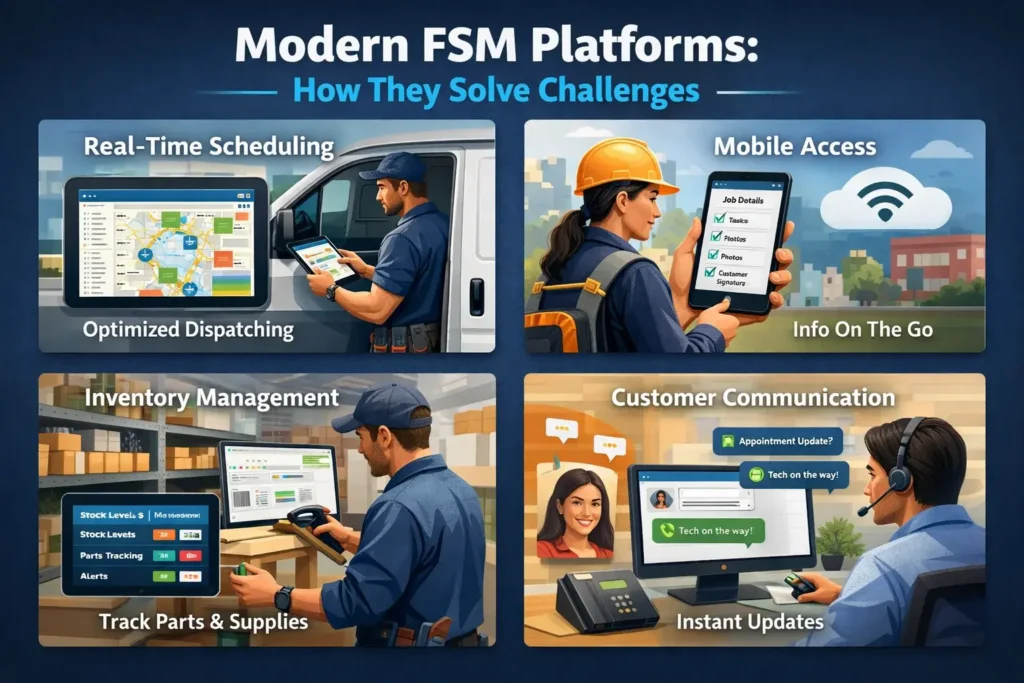
The modern era answers the question what is field service management software by utilizing it as the platform that prioritizes and highlights the use of field service automation as well as AI-generated insights, thus moving from Field Service Management (FSM) to Field Service Experience (FSX). TillerStack incorporates streamlined workflow and automated reports that help improve field service efficiency and transform traditional FSM challenges into business value. AI-driven technicians are driving themselves to pick jobs with the best staff and succeed on their first attempt.
The evolution from Field Service Management (FSM) to Field Service Experience (FSX) represents the next generation of field service operations, where organizations are encouraged to meet rising customer expectations while improving operational metrics. Organizations that harness TillerStack can achieve faster response times and elevate customer satisfaction.
Field Service Management Best Practices for 2026
Implementing field service management best practices in 2026 requires embracing innovation in scheduling, preventive operations, and customer transparency. A modern field service management strategy leverages micro-scheduling, a predictive maintenance culture, and service level agreement transparency charts to keep customers informed. Incorporating micro-scheduling and SLA transparency enhances technician efficiency by minimizing idle time and enabling them to resolve tasks efficiently, while keeping customers informed at every step.
TillerStack enables these practices together by improving overall field service workflow efficiency through AI-integrated scheduling, continuous monitoring, and automated reporting. By applying these field service management best practices, organizations can boost productivity, reduce costs, and enhance overall customer satisfaction. Using TillerStack enables companies to turn today’s challenges into opportunities for smarter service delivery.
Field Service Management Case Study (Real or Fictional)
As operational complexity and customer expectations rise, field services companies need effective solutions to stay competitive in 2026. It allows software such as TillerStack to simplify workflows by providing AI-driven solutions, thereby increasing the efficiency of field service work. Field service management case studies discovered that through field service management software, the percentage of first-time fixes can go up to 27%, and a technician’s daily workload can be increased by 2 to 3 jobs, all due to the optimization of scheduling and routing. Additionally, it has been reported that digital workflows have reduced administrative and travel costs by approximately 23%. With TillerStack, these features can be unified on a single platform to maximize efficiency and service quality.
With the implementation of modern field service management software, operations are completely transformed, resulting in increased productivity, reduced costs, and enhanced customer satisfaction.
Conclusion
The field service industry is accelerating toward a digitally driven 2026–2030, with the global FSM market projected to reach USD 9.2 to 11.5 billion by 2030.
Early modernization has paved the way for any field service organization today, enabling smarter scheduling, automated workflows, and predictive insights that will secure a stronger competitive position and more reliable service.
In addition, to stay competitive, every field service organization must shift toward AI, which optimizes advancing from reactive operations to proactive service delivery. Let TillerStack help you build a future-ready service operation designed for the next decade.
FAQS
What are the major issues in field work management?
Major issues include a skills shortage, complexity in equipment, increasing operational costs, and delays due to the need to send experts to the site.
What are the challenges of field work?
Field teams frequently encounter situations where they receive limited technical support, spend a significant amount of time traveling, run the risk of having repairs go awry, and experience inconsistent performance due to differing skill levels among workers.
What is field service management?
Field service management refers to the process of planning, coordinating, and supporting personnel who perform their duties outside the office, typically by walking or driving to the location of their work.
What are the field services?
Field services encompass a range of activities, including repair, installation, maintenance, inspection, troubleshooting, and on-site support of equipment across various industries, such as utilities, manufacturing, and telecommunications.
What is field service management software ?
Field service management software is a digital tool that allows businesses to coordinate their work, monitor technicians, and manage resources to make services and operations more efficient and effective.
How can field service providers overcome Field challenges?
For more efficient work, cost reductions, and improved repair work, remote support tools like TillerStack are available, which help providers call on a highly qualified expert for instant assistance.